


Your monthly SEO review should leave you able to judge what you paid for and what needs a decision next. A set of traffic and ranking charts can help with that. It can also leave the work behind those charts almost invisible.
To judge the month, you need an explanation of business results, search performance, completed work, anything delaying the work and the next priorities. Each claim should be traceable to evidence, with enough explanation to understand what to do with it. Report length tells you very little about either the evidence or the decision.
What the Executive Summary Should Tell You
The first page should explain the month in language you can use with the rest of the business. Did relevant search activity improve? Did it lead to useful inquiries or sales? What changed in the work, and what needs your attention?
A good summary acknowledges an important decline as readily as a win. If organic inquiries increased but the sales team rejected more of them, that belongs near the top. If important work is ready but cannot go live until a developer is assigned, that belongs there too. Neither should require searching through the appendix.
A page gaining clicks after an update is an observation. Saying the update caused that gain is a stronger claim, since seasonality, demand and other changes may also have played a part. The agency should separate what it observed from its explanation and make any remaining uncertainty clear. A reporting date alone cannot settle what caused the result.
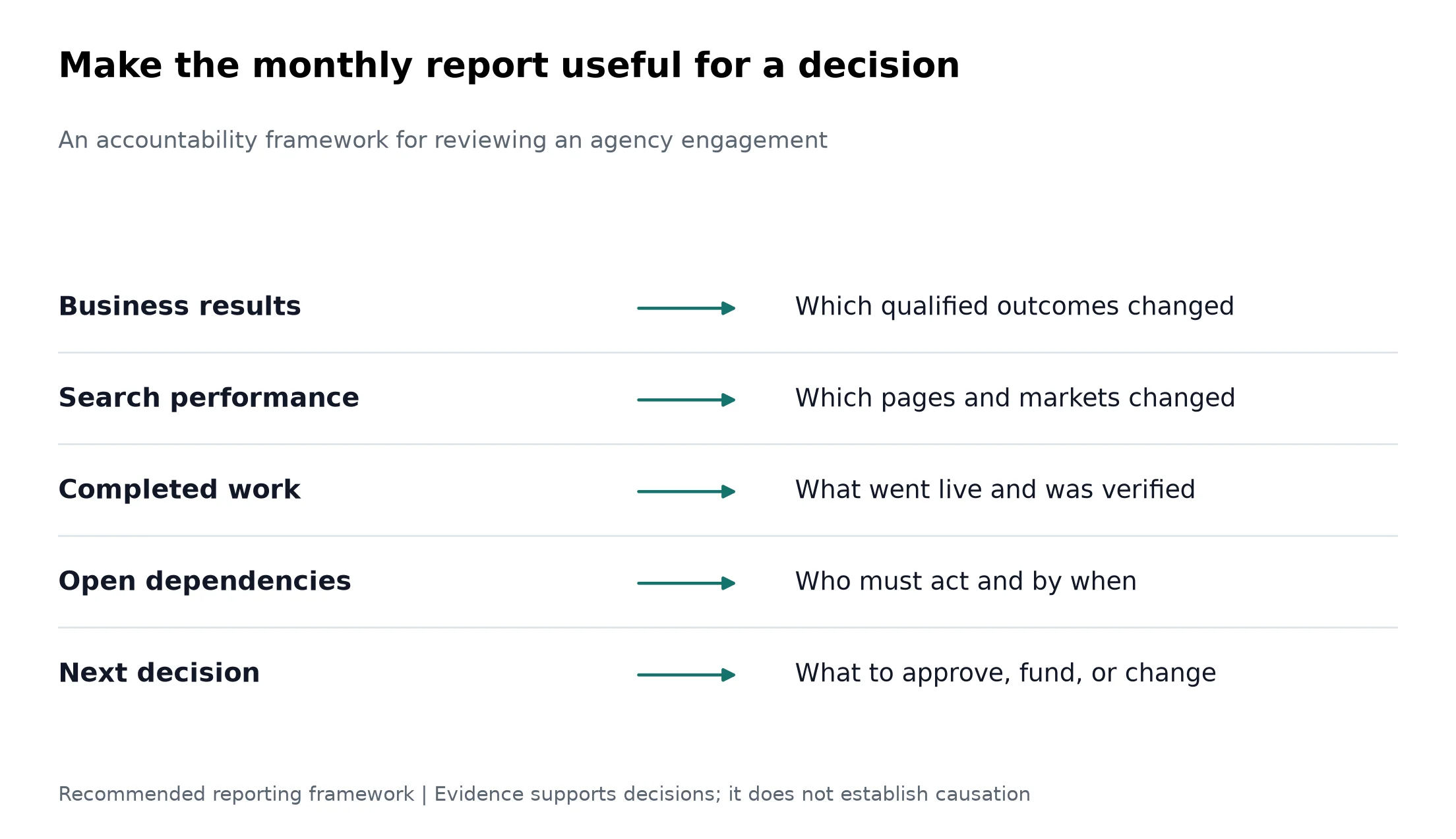
The detail behind the summary should remain available. You might need the affected URLs, event definitions or underlying comparisons to challenge an interpretation. The first page gives you a reason to open that detail rather than asking you to inspect every chart yourself.
- Agree which business question the first page must answer.
- Ask the agency to summarize the month's main outcome, any significant problem and the decision you need to make.
- Keep supporting reports accessible with the same date ranges and definitions.
Business Results With Clear Definitions
The report should explain what organic search contributed to the business using the best measurement you have. That might mean completed orders, qualified inquiries, booked appointments or a later sales stage. It should also say what has not been measured.
A form submission is not automatically a qualified lead. A phone-number click does not prove a call connected, and a connected call does not prove a suitable buyer called. These distinctions matter when an agency reports more conversions but the business sees little improvement.
Google Analytics calls important measured actions key events. The agency should specify the action, explain when it fires and show when it was last tested. If the report bundles a page view, a form start and a completed inquiry into one conversion total, ask for the important outcomes separately.
Businesses that collect leads can distinguish generated, qualified and converted leads where the tracking and sales process support those stages. The sales team may need to supply the later information. For an online store, match completed orders with the order system, then explain any gap in what Analytics recorded. Do not turn missing measurements into zeros or assume every tracked event is a different customer.
You also need to know how credit was assigned. A session that arrived through organic search is one reporting view. A sale partly credited to organic under an attribution model is another. Both can be useful, but changing between them without explanation can make a trend meaningless.
A worthwhile report keeps these definitions steady. When the business changes a form, checkout or qualification rule, the report should note the change so you know which comparisons remain fair.
- Mention the business outcome and the event or sales record used to count it.
- Show the count and any useful qualification stage, rather than a combined total of unrelated events.
- Record tracking changes, known gaps and the attribution view used for reported results.
Show What Was Implemented and Checked
A monthly work log should give you enough detail to check what the agency did. Ask for the page or ticket, what changed, when it went live and the check used to confirm the intended change. A count of optimized pages cannot do that job by itself.
The distinction between proposed and implemented work is especially useful. An audit may be complete while its recommendations are awaiting approval. A content brief may be ready while the article remains unpublished. Those are valid deliverables if they match the agreement, but they are different from changes that customers and search engines can encounter.
An illustrative work-log entry might say "Updated the product page's delivery information, published the revision, and checked that the live page displays the approved wording." That is much easier to assess than "improved product content." The URL and publication date would let the client open the work and check it.
Verification should fit the task. A redirect repair needs a check of the intended destination and response. A tracking repair needs a successful test of the event. A new article needs a live page that is accessible and eligible for indexing. The agency cannot promise that a technically eligible page will rank, but it can check the part it changed.
Task volume alone gives you little basis for judging that work. A difficult technical repair may require more thought and coordination than many small edits. Ask what problem the work addressed and what was delivered under the retainer. Counting tasks is useful for tracking a commitment, but the count cannot tell you whether every task has equal value.
This also gives you something fair to discuss in a month when results change little. The agency can show a repair that is working before search traffic responds. It should explain the observation it will check next, without presenting an increase in impressions as a guarantee that sales will follow.
- Require a URL, ticket or another record you can check for each important deliverable.
- Separate recommended, approved, live and verified work in the log.
- Check a small sample of completed items during the review and record any work that still needs to be handed over.
Search Performance That Explains the Results
Search data should help explain where useful demand is arriving and where it is being lost. A positive total for the whole site is less helpful when the page group you are investing in is declining.
The right comparison depends on the change you need to understand. Month over month can show recent movement. A comparable prior-year period can help with seasonal demand, if that history exists. Keep the dates, markets and page-group definitions visible. A change in what the report includes should not appear as an unexplained change in performance.
A percentage increase needs a count beside it to show its size. Doubling a very small number of relevant clicks may be encouraging, but it has a different commercial meaning from a large increase on established product pages. The explanation should say which pages or groups contributed to the change and why they matter to the current plan.
Search Console clicks and Analytics sessions do not have to match. They measure different interactions and use different collection rules. The agency should explain the purpose of each chart rather than trying to make two legitimate measures look identical.
Rankings, links and technical measures belong when they help assess the work. A ranking change may support a page-level investigation. A resolved technical issue may verify a repair. An authority score can provide limited context. None should stand in for the outcomes the business agreed to pursue.
The same standard applies to local and AI work. Ask for the measures relevant to the contracted task and their limits. Local profile interactions are different from booked jobs. AI appearances are different from customers. A report should preserve those distinctions without adding an entire new dashboard because a channel is fashionable.
- Keep the comparison dates, relevant markets and page groups consistent.
- Include important losses alongside gains and explain the next investigation.
- Ask what decision each recurring chart helps you make, and remove charts that no longer serve one.
Blockers Need an Owner and a Date
A note saying "waiting on the client" does not give the business enough to act on. Which approval is missing? Who can provide it? Which work will remain paused until it arrives?
When work is delayed, record what is needed, who must provide it, when it is needed and what happens if it is late. If product details are missing, identify the pages affected. If a developer is unavailable, identify the repair awaiting deployment. This gives you enough detail to discuss the delay without pretending the agency controls every resource.
The agency still has responsibility for raising the issue and adjusting the plan. Repeating the same blocked task month after month while billing against an unchanged plan deserves an explanation. Ask what useful work can proceed and what tradeoff a different priority would create.
Measurement gaps count as dependencies too. If sales never marks qualified leads, the agency may be unable to report their quality. The response should be a specific request and an agreed fallback measure, with the limitation stated. A guessed customer number would make the report less useful.
- Make someone responsible for each significant problem delaying the work, and agree on their next action.
- State which deliverable or measurement the blocker affects.
- Agree what work will proceed if the delay continues past the due date.
Agree Who Will Do What Next Month
The next plan should show what the agency will prioritize, why that work deserves attention and what it needs from you. It should also say what the agency intends to stop or postpone. A longer task list is not automatically a better plan, especially when the previous month's work still needs checking. You should leave the review knowing which approval, resource or business choice is yours, what the agency will deliver, and when you will assess progress. That is a more useful basis for the next invoice than another promise that the charts will improve.
- Agree the next priorities and the evidence supporting them.
- Confirm the deliverable, responsible person and expected handoff date.
- Record your approvals or resource commitments in the same plan.
- Set the next review around the work and outcome checks that will be ready by then.