

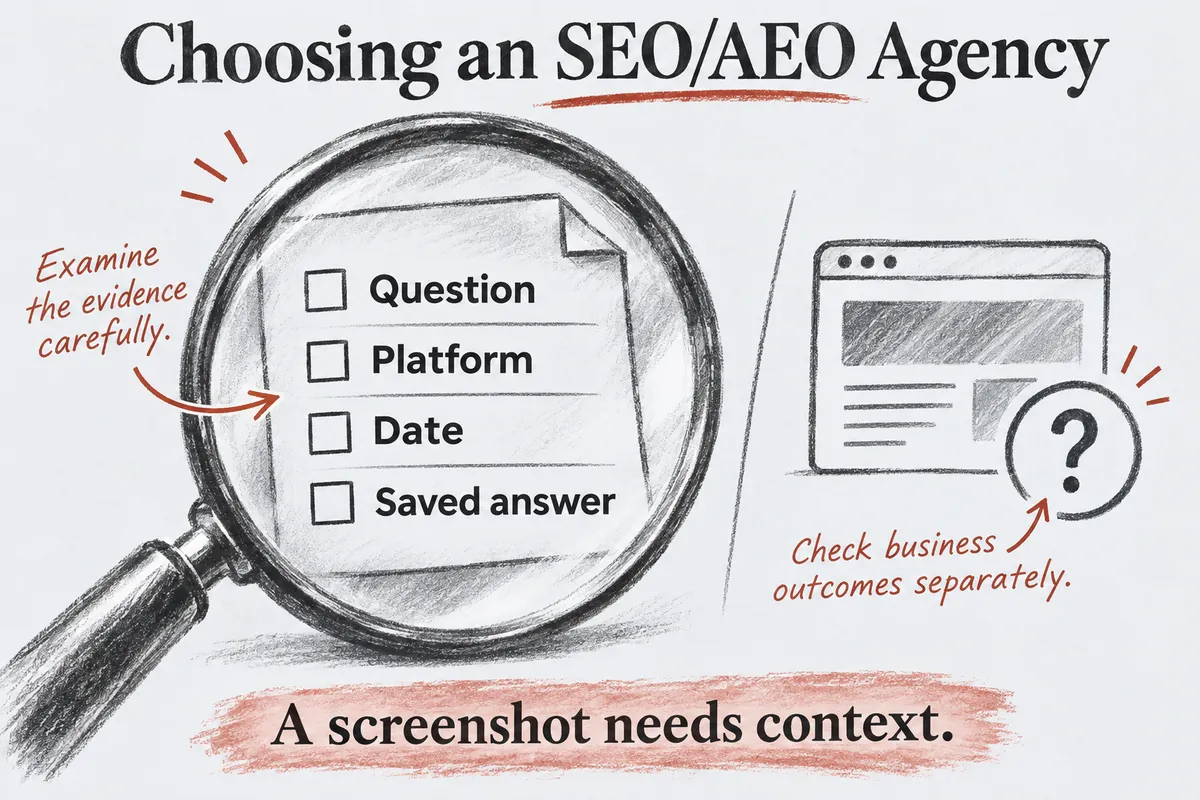
An agency can show you an AI answer that mentions your business and still leave a lot unexplained. Which question produced it? Would a buyer ask that question? Did the agency change anything that helped you appear, or did it find an answer that was already there?
If you're paying for answer engine optimization, usually called AEO, you need to know what the agency will do. The team should be able to improve your website and explain its changes, with reporting that shows whether more of the right people can find you. A collection of favorable screenshots won't tell you all of that.
You may already have an SEO agency that can do the work. Before adding another supplier or a separate fee, compare what each proposal buys.
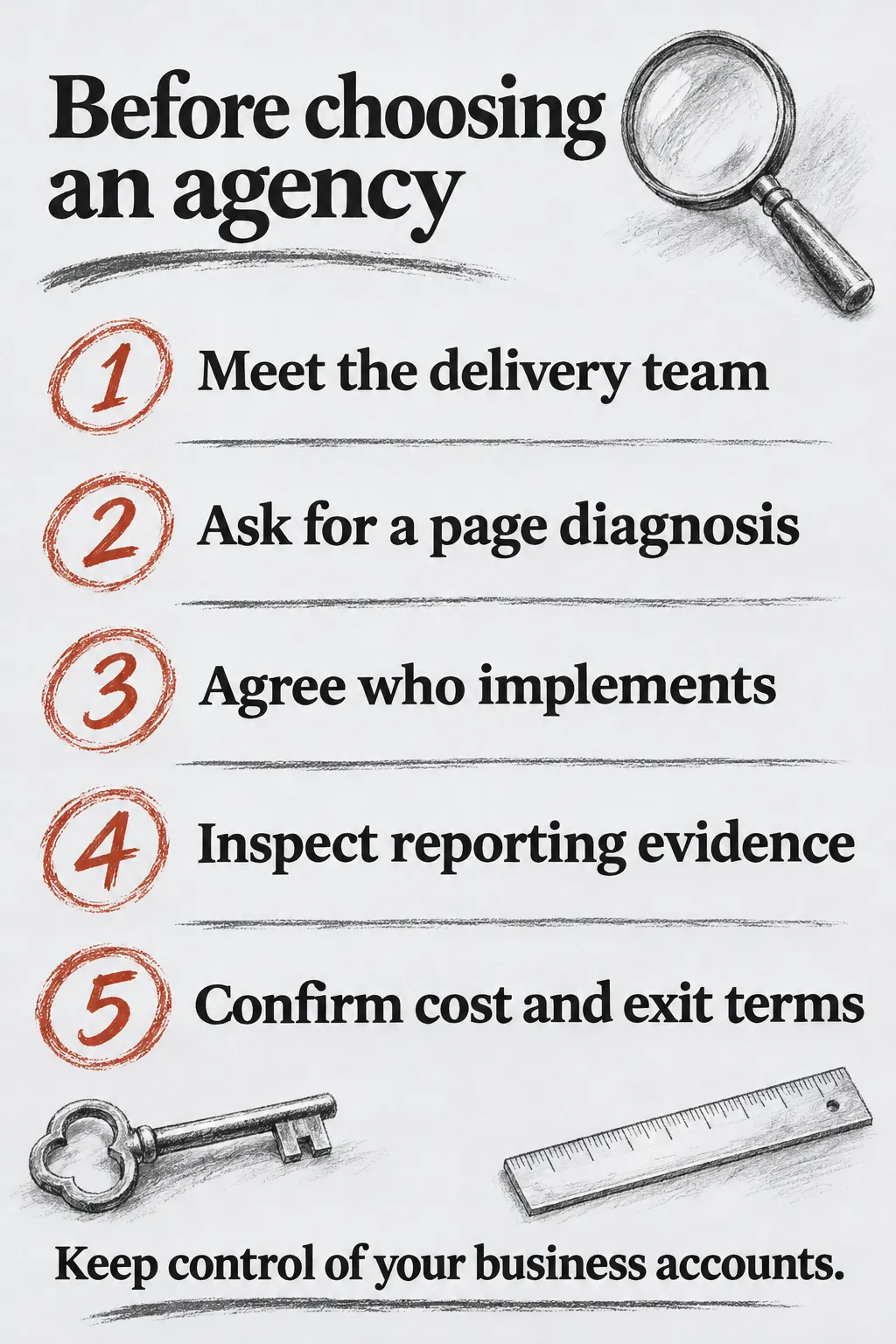
1. Check Relevant Work and the People Doing It
Ask for one example that resembles your business in a useful way. The same website platform, a similar buying process, or experience in your market can matter more than a recognizable client logo.
A useful case includes the starting problem, the dates, the work completed, and the results. If it shows improved visibility in AI answers, ask which questions and platforms were checked. Find out whether the website also changed its products, advertising, or content during that period. Those details help you judge how much the example can tell you about the agency's contribution.
You don't need another company's private analytics account. A redacted report and a reference who has agreed to speak can answer the important questions. Ask that reference whether the agency delivered its promised work, explained delays, and made recommendations the business could act on. A polished chart says little about those parts of the relationship.
Then meet the people who would do your work. Find out who handles technical problems and who writes the content. You'll also need to know who checks whether a page describes your services correctly. A strong sales conversation is useful, but you'll also need someone who can work through a broken template or revise an inaccurate service description.
Keep the case study with the proposal and compare it with the responsibilities of your proposed team. Experience elsewhere is less useful if none of the people responsible will be involved in your account.
2. Ask for a Diagnosis of Your Business
Give the agency a real page and a few questions your customers ask before buying. Ask what it would investigate first, what it would change, and why.
For a local contractor, the priority might be clear service coverage, accurate business information, and a working inquiry form. A software company may need better explanations of integrations, setup requirements, and differences between plans. The agency should be able to explain why your particular problem deserves attention before proposing a set number of new articles each month.
Ask it to put that diagnosis in writing, using a page from your site as an example. The agency should explain which customer question the page fails to answer and how it would fix that. You can check the reasoning against your own sales conversations. Your staff should recognize the question and be able to confirm the answer.
The same test helps you assess the extra AEO fee. Google's AI search features use its search index and core search systems. Useful content and sound technical SEO still matter. Google doesn't require special AI schema, and it ignores llms.txt for Search visibility. An agency that offers those items should explain what else it will do and what each item is meant to achieve.
Other platforms need their own checks. For ChatGPT search, the agency needs to check that OAI-Searchbot and its published IP addresses can access your site. That requirement alone doesn't mean you need a separate AEO supplier.
A focused diagnosis may show that your existing team can handle the work. If an agency finds one fix you can make in-house, weigh that against the cost and responsibilities of a continuing engagement.
3. Find Out Who Will Make the Changes
An audit can identify a good opportunity without getting anything published. Before agreeing to a fee, ask for a written scope that says who will get each change onto your live website.
The scope should say which pages or templates are included, who writes or edits them, who approves the facts, and who publishes. Technical changes need the same clarity. If your developers must implement the agency's recommendations, find out how much of their time the plan assumes. Ask your developers whether they have that time before the contract starts.
A proposal that offers "Technical SEO support" could mean the agency will fix problems or write instructions for your team. It could also mean attending a monthly call. Each can be useful, but you need to know which one you're paying for because they require different budgets and different people on your side.
Ask how the agency will check its work, using one task as an example. If a security setting blocks a search crawler, the task should cover changing the setting and checking access again. If a service page gives an outdated answer, someone should approve the correction and verify that the live page displays it properly.
After an inquiry-form change, send a test inquiry and confirm that the right person receives it. A page can look correct while its form sends requests to an inbox nobody checks.
Growing Search offers technical SEO, content work, and AI visibility services. If your proposal includes those services, ask how the people handling each part will pass work to one another. The written scope should also explain what happens when a task needs more development time than the fee includes.
4. Inspect the Reporting Before You Sign
Request a sample report and an export of the evidence behind it. You should be able to follow a reported change back to a question, a page, or a completed task.
For AI answer tracking, inspect the question list first. Ask where the questions came from and which customers they represent. Broad prompts about your industry may miss the detailed questions buyers ask when choosing a supplier. Sales calls, support requests, and on-site searches can help the agency build a more useful sample.
You should be able to see which platforms and modes the agency checked and when it checked them, along with any relevant language or location settings. The report should explain how checks are repeated and include answers that didn't mention you. Ask how it handles a changed question list. Adding easier questions halfway through the engagement can make the next chart look better without showing an improvement on the original questions.
The report should distinguish a mention from a linked citation. You'll need to track qualified inquiries separately from both. If your business appears in 10 of 50 sampled answers, that describes those checks. It doesn't mean you appeared in 20% of every answer your buyers saw.
Ask how the agency will use available platform data alongside those samples. Google Search Console has a dedicated Generative AI performance report, though sites with too few impressions may not see it. Bing Webmaster Tools also provides AI citation reporting. These reports observe different things and shouldn't be combined into a single unexplained visibility score.
Agree on the business results you'll review, too. You need to see relevant organic visits and completed inquiries, then find out which inquiries your sales team considers qualified. Check the starting period and test the tracking. When results change, the agency should discuss other possible causes, including demand and platform changes. You can ask for a commitment to completing the work and reporting carefully, though the agency can't promise that a platform will cite your page.
5. Compare the Full Cost and the Exit Terms
Compare prices once you've checked that each proposal covers the same work. Include setup fees, content and revision limits, developer time, tracking tools, and charges for work outside the agreement. Ask for the cancellation notice and handover terms in writing.
Keep control of your website and business accounts. Keep a verified Search Console owner under your business's control. Google recommends read-only access during an initial audit; later permissions should fit the agreed work.
Specify what you can keep using when the engagement ends, including commissioned content, reports, question lists, and saved answer evidence. An agency's software license or existing methods may have separate terms, so clarify them instead of assuming everything transfers. Check that exports contain usable history and that the handover covers account access as well as files.
Choose a team whose diagnosis makes sense for your business and whose promised work you can check. The total cost should fit your budget, including the time your own people will need to spend on it.