

Consider a hypothetical business that serves customers in Canada. Its monthly Google organic clicks rise from 1,500 to 1,800. That is a 20% increase, which looks encouraging until the business separates the countries.
Canadian clicks fell from 1,000 to 800. Clicks from other countries doubled from 500 to 1,000. The total improved while the market the business serves lost 20% of its clicks.
These are illustrative numbers, not client results. They show why rising overall search traffic can leave a business with less of the demand it needs. The problem deserves attention even if every overseas visit is legitimate.
Global growth is a weak basis for judging progress when it hides a decline in the market the business serves. Judge results in the target market separately. Check the totals, the pages and searches that changed, and how many suitable buyers came from those visits. A positive global total cannot answer those questions for you.
Separate market loss from a smaller traffic share
A falling target-country share is a reason to look closer. It is not proof that the country lost traffic.
The hypothetical Canadian business had an absolute decline in clicks from Canada. But imagine that Canadian clicks had risen while other countries grew faster. Canada's share could still fall. Calling that a target-market traffic loss would misread the numbers in the other direction.
Put the current and previous counts beside the shares. Did the business lose useful visits, or did those visits grow more slowly than traffic to the rest of the site? Did it lose clicks while the mix of countries changed too? Those situations may require different responses.
The expanding audience also deserves a closer look. An informational article can attract readers around the world while commercial pages struggle in the intended market. Growth on the article may be worthwhile. It cannot stand in for the product-page performance the business is trying to improve.
Nor does growth abroad prove that those readers caused the decline at home. The total adds the clicks together. It does not show that growth in one place caused a loss in another.
- Show each target country's old and new click counts alongside its share of the total.
- Find which pages grew elsewhere and which lost useful visits in the target country.
- Record whether clicks fell or simply grew more slowly than clicks from elsewhere.
Define the countries the business can serve
Your target market should come from the business plan, not the country at the top of a traffic report. Where you ship or serve customers matters, as do the licenses and sales staff you need. These can all affect whether an interested visitor can become a customer.
A country can still be too broad a measure of that market. A service business that works in one province cannot treat every visit from Canada as equally useful. A store may ship across the country but exclude some products or places. A country report can show a large gap between where visitors are and where you sell. It cannot show every rule that makes a buyer a good fit.
Country is also different from language. Canada includes English- and French-speaking audiences. English content can reach readers in several countries. A visit from the US does not prove that a Canadian page has the wrong language settings. Nor does a visit from Canada prove that the person saw the page in the right language.
A growing audience in another country may justify research into selling there. That opportunity is worth recording while keeping the current goal clear. Until the business decides to sell there and does the work needed to serve customers there, report that growth apart from progress in the current market.
- Write down the countries and smaller service areas the current search work is intended to support.
- List the product, shipping or service rules that affect who can buy.
- Assess the sales opportunity in new markets, and report their growth separately from results in the target market.
Read search performance within the target country
Filtering by country is only the beginning of this assessment. A country total can still hide gains on pages that do not help the business and losses on pages that do. You need to see what changed within that market.
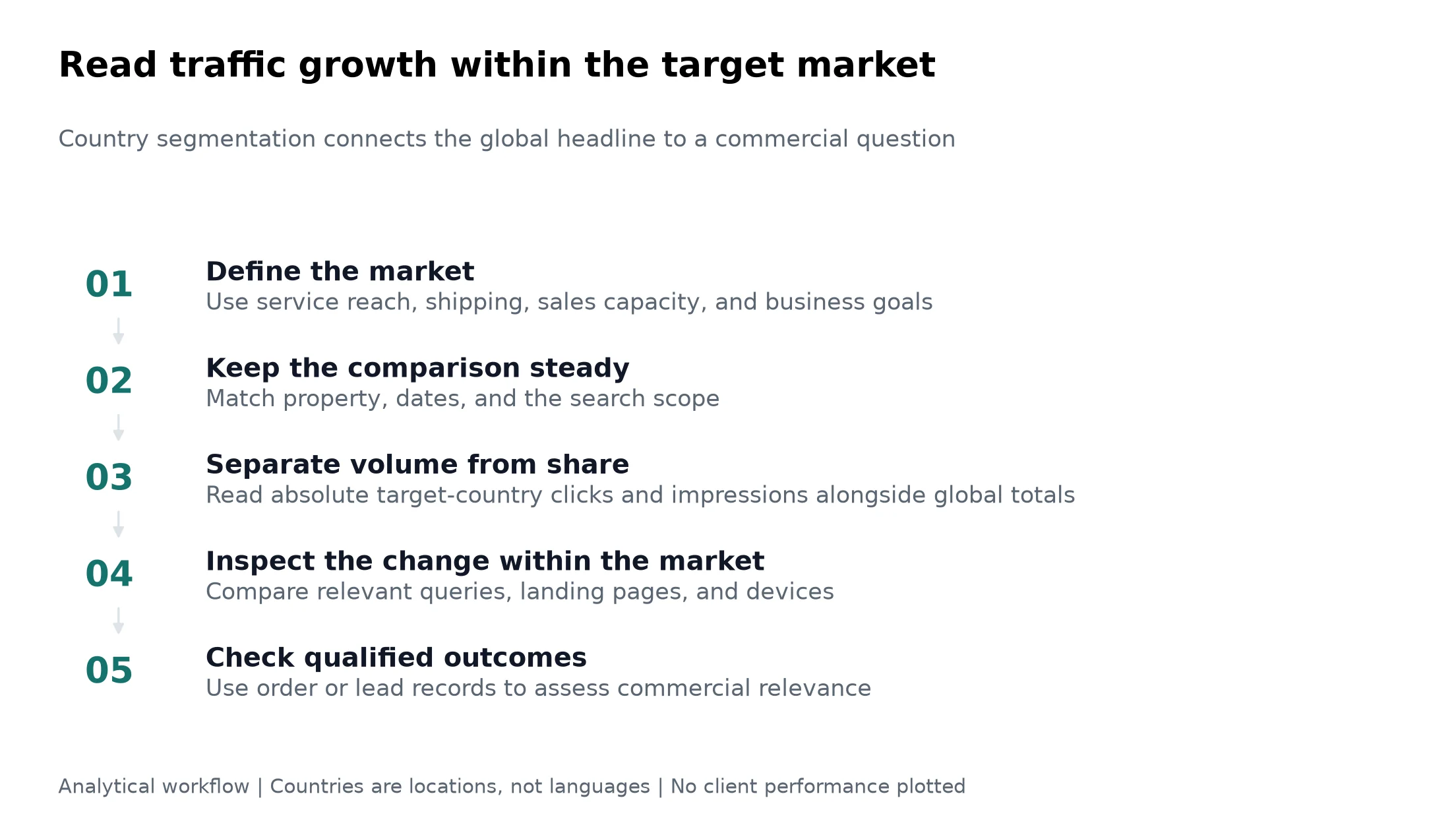
In Search Console, use the same property, dates and search type for a fair comparison. Filter the Search results performance report to the country, then review Queries and Pages. Check whether results on each device help explain the change. Use full periods you can fairly compare. Compare with the prior year too if the business is seasonal and you have the data.
A change in demand for your company raises a different question from a change in demand for a type of product. Look at searches for your brand apart from other useful searches where your data lets you do so. Group pages by what they do for the business too, so global blog traffic does not hide results on local service pages.
Impressions, clicks, click-through rate and average position help you distinguish the possible changes. If the same queries keep similar positions while impressions fall, check demand and seasonal changes. If position weakens for important queries, investigate what changed in the relevant results and pages. You need to check further before either result tells you the cause.
Overall CTR is total clicks divided by total impressions for the data you selected. Taking the mean of country CTRs gives small and large countries equal weight, which can give you the wrong answer. The combined rate needs to reflect how many impressions each country contributed.
Average position needs its impression weights too. If your dashboard rebuilds it from Search Console bulk exports, divide summed position totals by summed impressions and add 1, because that export stores positions from zero. Do not add 1 to the average position already displayed in the regular report. Keep property-level and page-level data separate when rebuilding totals, and do not combine overlapping segments.
Even a correctly calculated average can reflect a changing mix. New low-ranking queries can worsen average position while the same sales-related queries stay steady. Check what happened to the same useful queries and page groups within the market.
Keep that consistent group alongside the full country total. The fixed group helps you judge the work you have made a priority. The full view lets you spot new searches and pages that might need work. If you leave out all new queries to make the reports easier to compare, you could miss a chance to grow. If you change the group each month, you may no longer be able to judge work already in progress.
- Save a country-filtered comparison with the same dates and search type each time.
- Review which page groups and devices changed, and what those searchers wanted.
- Check that dashboard formulas weight totals correctly and group data the same way before you judge the trend.
Check whether qualified inquiries and sales changed
Search Console shows how people found you in Google Search. Your analytics and business systems help explain what happened after people arrived. You can use both to make decisions when they focus on the same market and page groups you care about.
In GA4, check the target country's organic visits, landing pages and the business outcomes you chose to track. If you are comparing with Search Console, distinguish Google organic traffic from traffic arriving through all search engines. State which traffic the report includes rather than switching between those measures.
Clicks and sessions will not always match. The products use different collection, time-zone, attribution and URL rules. A country filter does not create a record linking each Search Console click to an individual order.
The place Analytics records is not always the buyer's shipping or service address. A visitor abroad might be researching for a business in your service area. A visitor located nearby may want something you do not provide. Sales, order or booking records help you check whether buyers are a good fit.
If useful clicks stay steady while suitable inquiries fall, check the offer and the steps a visitor takes to buy or contact you. Whether products are in stock, delivery terms, form errors and lead quality may matter more than where global traffic comes from. That calls for different checks from those you use to find out why pages lost search visibility.
- Compare the landing pages that receive organic visits from the target country with the qualified inquiries or sales you can verify.
- Check that you can serve or ship to buyers using the details the business collects for that purpose.
- Note tracking changes and gaps before treating a missing outcome as a failed visit.
Choose a response to the market problem
The change found within the target market should guide the next action. You may need to adapt content for a market. But a change in the mix of countries does not by itself mean you should change hreflang or block visitors from abroad. Hreflang tells search engines which page versions are meant for different languages or regions. It does not prevent people abroad from visiting, and the old Search Console country-targeting control is no longer supported. A sudden spike from one place may give you a reason to check sources and traffic quality. The recorded country alone does not tell you whether a visitor is a bot.
- If useful demand seems to be falling, check search interest and seasonal history before you rewrite pages.
- If important queries or locale URLs lose visibility, check those pages, their selected canonical and the versions for other markets.
- If useful visits arrive but outcomes weaken, test the form or checkout and review sales qualification.
- If analytics shows a surge from one place that you cannot explain, check the traffic sources and ask for evidence before deciding on a cause.
- Record what you will investigate, then check the same target-market measures again after verifying any changes you make.