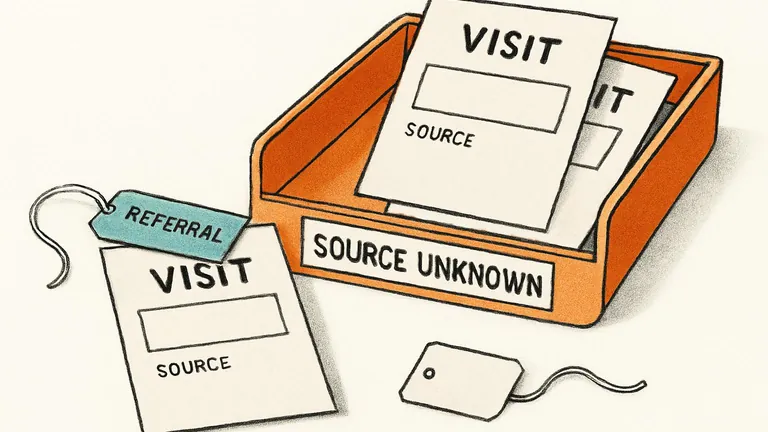


A growing list of AI mentions can tell you that your business is becoming more visible. Whether that visibility helped someone become a customer is harder to tell.
Some of the answer can be measured directly. You know which assistant sent a visit, the visitor completes an important action, and your business records confirm it. Other journeys leave less evidence. Someone may read a recommendation, search for your name later and buy without ever clicking the assistant's link.
Those journeys support different conclusions. A customer outcome linked to an AI visit with a known source gives you a count you can check. Other signs that AI helped are useful, but they cannot supply a precise customer count. Keeping the two separate lets you judge the next investment without overlooking what the measurement still misses.
| Evidence | Supports This Statement | Does Not Establish |
|---|---|---|
| Recorded AI source linked to a confirmed order or qualified lead | An outcome was associated with an identifiable AI visit | The customer would not have arrived otherwise |
| Google AI impressions or sampled citations | The site or brand appeared in the measured setting | How many customers those appearances produced |
| A buyer says an assistant recommended you | That buyer recalls AI influence | A complete count of AI-influenced buyers |
| A credible controlled comparison | An estimate of the intervention's added effect | A guaranteed return in another business |
Which customer outcome are you trying to measure?
The outcome you choose determines what the channel's results mean. If you sell online, a completed order is more useful than an add-to-cart event. If you sell a service, an inquiry may be the first measurable stage, but a qualified inquiry or booked appointment may tell you more about its value. Set that outcome before judging the channel.
A signup can be an outcome too, but it does not necessarily mean you have gained a customer. Decide whether the business needs a free account, an activated account or a paying subscriber, and keep that distinction in the report. Otherwise a change in wording can make early interest look like revenue.
In GA4, important measured actions are called key events. Select the event that matches the question you are asking, and check what makes it fire. A form start and a successful submission are different events. A successful submission can still be a duplicate, spam or a request from someone you cannot serve.
A rate also depends on what you count. For a session-based rate, divide sessions containing the selected outcome by the eligible sessions. Dividing every repeated event by the session count would answer a different question, so do not label that result a customer conversion rate.
For a hypothetical example, 2 sessions containing a purchase among 20 eligible AI sessions give a 10% session purchase rate. That does not establish 2 new customers, since an existing buyer could place an order. It is also a small sample. Just one more session with a sale would change that rate a lot.
Counts beside the rate make that small sample visible. Later sales stages, where the business tracks them, also show how far those outcomes progressed. Reporting both prevents an impressive percentage from doing more work than the evidence can support.
- Record the outcome, the unit you are counting and the event or business record that confirms it.
- Select that event in the report rather than combining unrelated key events.
- Include the numerator and denominator with each reported outcome rate.
Find identifiable AI visits in GA4
When your property records an assistant as the source, you have evidence of an AI visit without having to infer it from other behavior. The next question is which of those sources the current reports include and where their coverage stops.
Audit the AI Assistant channel
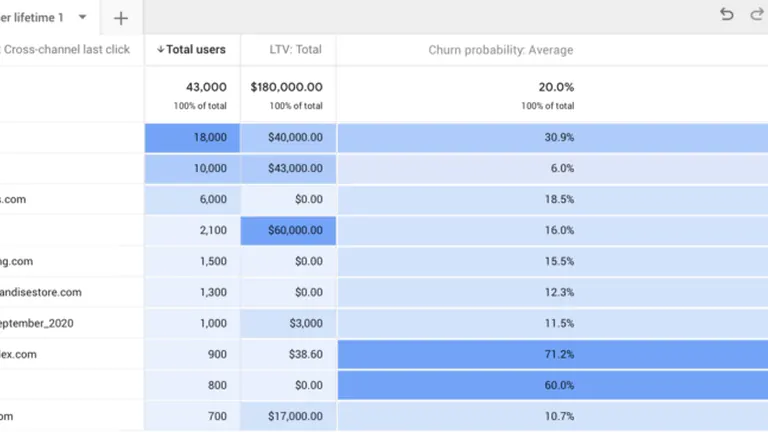
In GA4, open Reports, then Acquisition, then Traffic acquisition. Look at AI Assistant under Session default channel group. This default channel now groups visits from the assistants it supports. Advice that assumes every AI visit must be found inside Referral is out of date.
Known assistant sources may appear outside the default row, so inspect Session source / medium as well. Look for the assistant sources your property records and check whether the channel grouping treats them as expected. You still cannot identify the source of a visit if it was never recorded.
If you need a custom channel group, build it from verified source values and test its rules against your existing data. The order of the rules matters when more than one rule could match a visit. Keep a record of the definition and the reporting dates it covers, so a classification change does not look like new customer demand.
Keep Google AI reporting separate
Google AI Overviews and AI Mode are excluded from GA4's AI Assistant channel. Their non-ad search visits remain in Organic Search. The AI Assistant total is therefore not a count of every visit involving an AI search experience.
Search Console provides another view. Its generative AI Search performance report measures impressions for AI Overviews and AI Mode, with page, country, device and date views. Google said the report was available worldwide as of August 31, 2026. A site may still lack the report if it has not had enough impressions that meet the criteria.
As of November 2026, that report shows where a site appeared. It does not connect an impression to an individual customer's order. Its data is also part of overall Web search reporting. If you add the AI impressions to that total, you count some of the same data twice.
- Check the default AI Assistant row and its underlying source/medium values.
- Document any custom grouping and compare its included visits with the original reports.
- Keep Google AI impressions in a visibility view, separate from the assistant-referred customer total.
Can you follow the visit through to a customer?
Finding a source row does not prove that the rest of the journey is being recorded. The link can work even if your tools fail to record a signup or sale later in the journey.
Test the route a customer takes. Follow an assistant link to the landing page, complete the relevant form or purchase flow, and check the intended event in Realtime or DebugView. If checkout or account creation moves to another domain, include that move in the test. A login provider or payment page can complicate how the source is retained.
A link opened in an app may behave differently from a link opened in a desktop browser. Include the ways people are likely to arrive in your test, and check the source information your setup receives. Do not assume every assistant app strips the same parameters or that adding a server-side event will restore a missing referrer.
The order, booking or customer system gives you another way to verify the outcome. Where your setup can link the two reliably, match the analytics event to the business record and check for duplicates. The business system can confirm that a sale occurred even when analytics failed to record it. It does not by itself tell you which channel deserves credit for the missing visit.
When the sale happens later
An AI visit may begin a journey that finishes through email, branded search or another channel. Session acquisition tells you how that session began. Event-scoped attribution can distribute credit among observed interactions before a key event. Those are different questions, so make clear which reporting view you are using.
Attribution paths can help you see recorded assisting visits and the time before an outcome. They cannot trace every suggestion someone read without clicking a link. A report assigning partial credit to AI is still assigning credit under rules and available data, rather than proving the visit created a new customer.
Check outcomes after the sales cycle
A fresh inquiry and a closed sale from an older inquiry should not be judged as though they had the same time to convert. If sales usually take several weeks, recent AI leads may still be open when you prepare the report. Mark them as pending rather than failed.
State when the leads first arrived and when you checked what happened to them. You might report leads acquired during one month, then update their qualified and converted status later. Show new outcomes separately from updates to an earlier group so a delayed sale does not disappear or get counted twice.
- Complete a test purchase or submission through each important domain or handoff in the customer's journey.
- Match recorded outcomes with orders, bookings or customer records where a reliable link exists.
- Say which attribution view you are using and flag recent groups of leads that have not had time to finish their sales cycle.
What about recommendations that produce no click?
Customer recall is useful evidence. If a buyer tells you an assistant recommended the business, save that response in an appropriate sales or post-purchase field. You have learned something that a referral report may never show.
That response needs to remain distinguishable from a tracked visit. A customer who recalls ChatGPT may also have a recorded ChatGPT visit. Adding the two counts without checking would count the same person twice. Other buyers may recall the advice but forget which tool gave it.
Branded-search growth can support an investigation, but it does not identify the cause by itself. Advertising, public relations, repeat customers and offline recommendations can all lead people to search for a name. A rise in Direct traffic cannot tell you how many AI visits went unrecorded either.
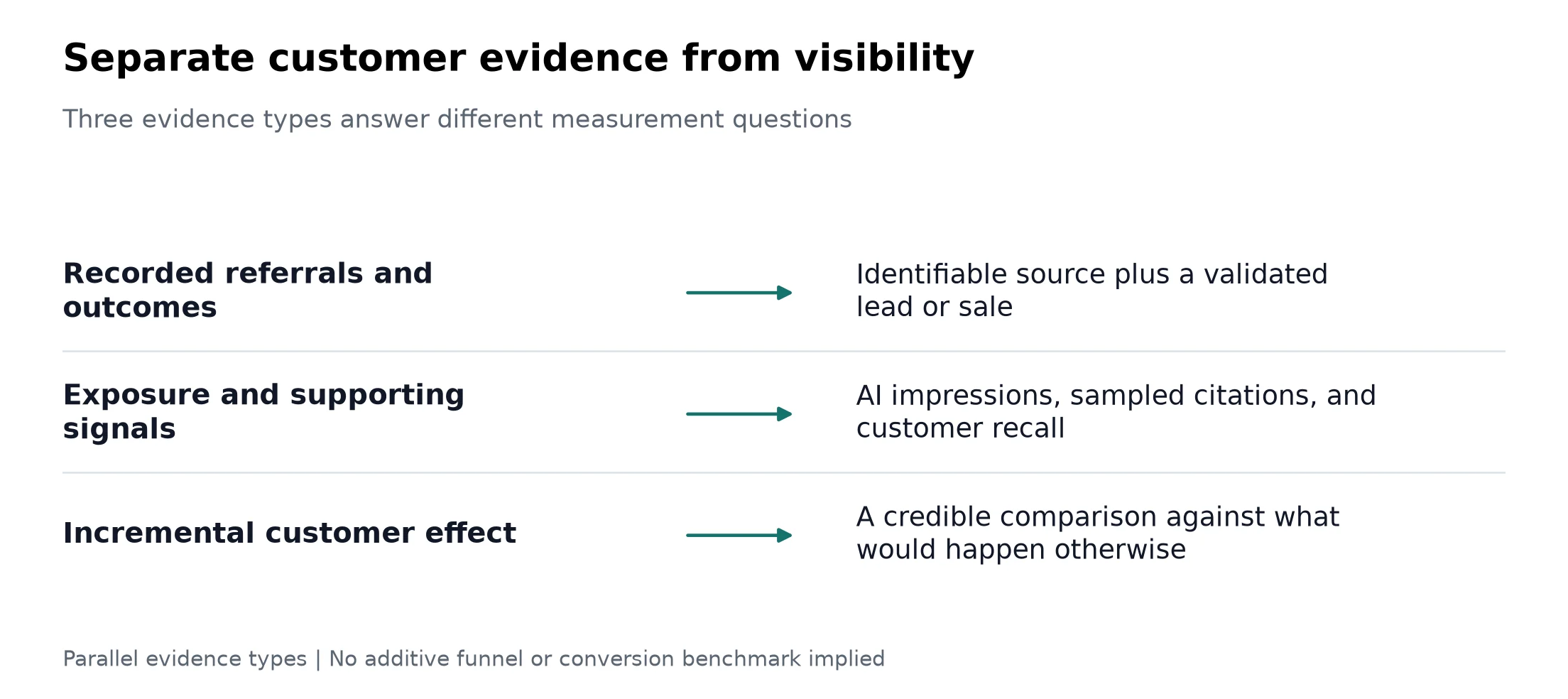
Prompt monitoring can add evidence about visibility alongside those broader traffic trends. A repeated set of relevant questions can show changes in whether an assistant mentions or cites you under those test conditions. Keep the questions, market, model and checking dates visible. The sample does not represent every customer question, and the percentage of sampled answers mentioning a brand is not its customer conversion rate.
- Add an optional question about whether an assistant recommended you at a suitable point in the existing customer journey, and keep its wording stable.
- Check whether a buyer appears in both sets of records before you add their responses to the tracked customer count.
- Report prompt samples, Google AI impressions and branded-search trends as supporting signals, and explain what each can and cannot tell you.
Did your AI work cause the improvement?
More AI-referred customers would be a useful result to observe. It would not, on its own, prove that an optimization project produced the increase. More people may have started using the assistant. Or the business may have changed its offer and won more buyers from several sources.
A higher conversion rate also falls short of showing that AI traffic is inherently more valuable than another channel's. The visitors may arrive on different pages, know more about the product, or include a different share of returning buyers. The comparison can show how those groups differ without proving that the assistant made them more likely to buy.
Compare similar pages, customer types and markets where possible. Watch how many buyers arrive and whether they are a good fit as the months pass. A small source that produces a few suitable buyers can deserve attention without supporting a stable forecast of its next month's conversion rate.
A causal claim needs a stronger design. A sound comparison group, measured before and after the work, can help show which changes came from the work and which would have happened anyway. The groups need to be alike enough for a fair test. The work should not affect the control group in the same way. Short histories and other changes made at the same time weaken the conclusion.
For a small business, that level of testing may be impractical. You can still run a small project and state what result would justify more work. Treat the outcome as a sign of what may be working. You do not need to call that a proven incremental return to learn from it.
- Compare outcome counts and quality alongside rates, using similar periods and audiences.
- Record changes in offers, tracking and other marketing that could affect the result.
- Only claim that the work brought in extra customers if the evidence supports that causal comparison.
Decide what the evidence justifies
More spending on AI search is easier to justify when visits from known sources keep leading to useful business outcomes you can check, and the reporting passes these checks. If the only improvement is visibility, a smaller exploratory project may be more sensible. If visits arrive but outcomes disappear during checkout, invest in fixing the measurement before judging the channel. The decision can change as the evidence improves. The team needs to know which observation would support continuing, changing or stopping the work.
- Keep attributed outcomes and supporting visibility signals in separate parts of the report.
- Set the next decision date around a realistic sales cycle and enough relevant observations.
- Write down what evidence would justify the next spending change before the project expands.