
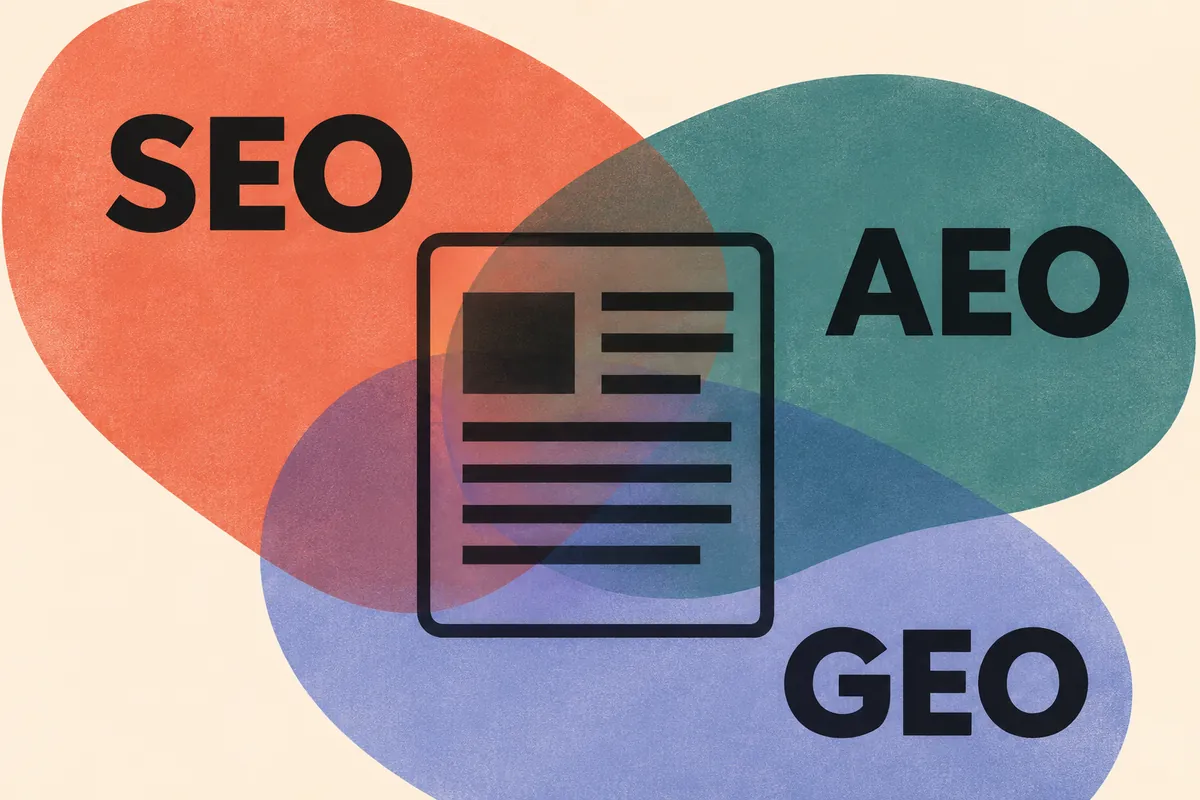
SEO helps people find and assess your website through search. AEO focuses on getting useful information selected for direct answers. GEO aims to improve how your business and its content appear in AI answers. The work overlaps because a search engine can use the same page in several kinds of results.
The acronyms can make that overlap sound more complicated than it is. SEO means search engine optimization. AEO means answer engine optimization, and GEO means generative engine optimization. Their boundaries depend partly on who's using them. An AI Overview can count as an AEO result or a GEO result, so those labels alone won't tell you what a service includes.
The useful distinction is the result you're trying to improve and how you'll check it.
| Term | Main emphasis | Example result | Observation to measure |
|---|---|---|---|
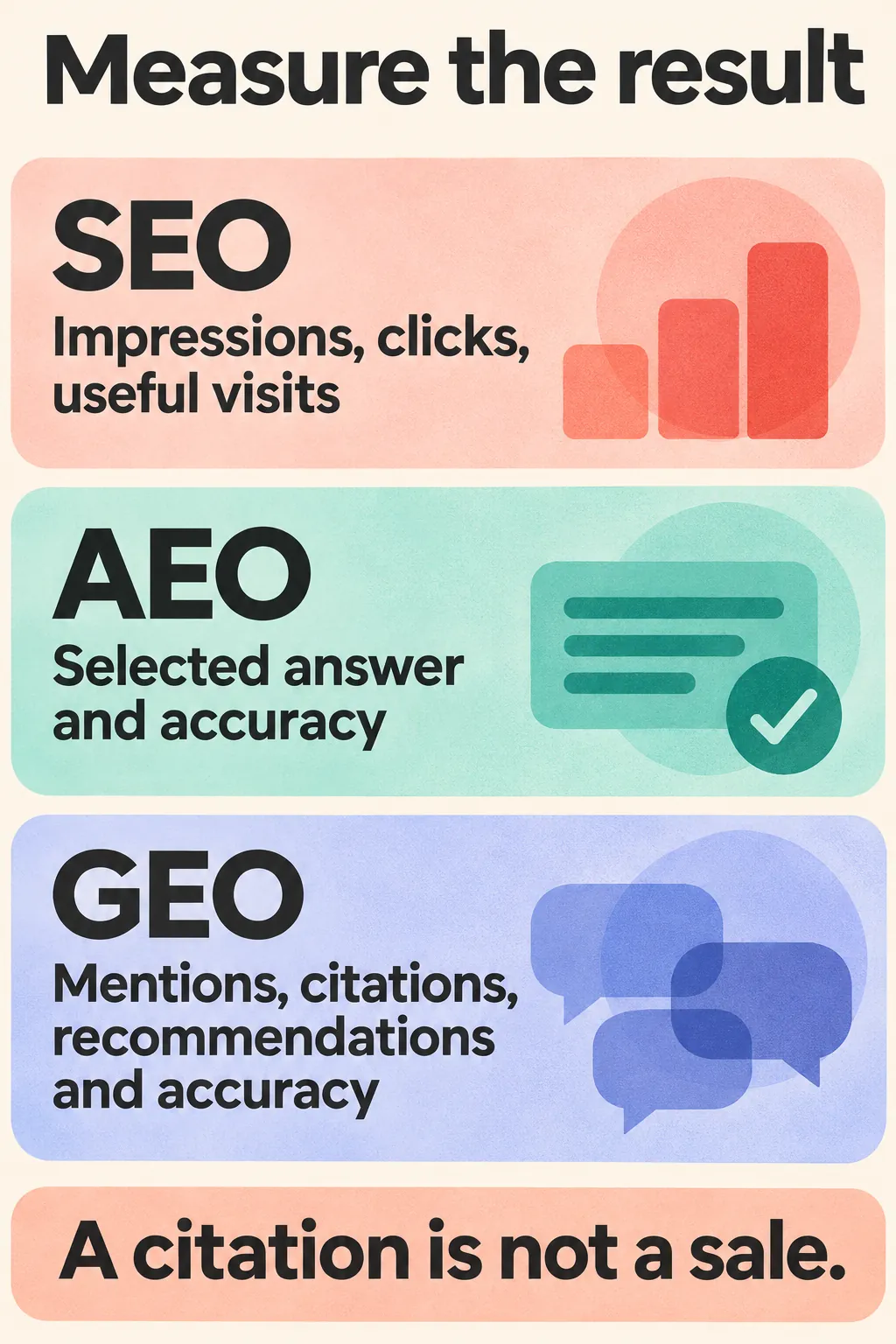
| SEO | Search discovery and useful organic visits | A service page appears in search results | Impressions, clicks, and relevant conversions |
| AEO | Selection as a direct answer | A page supplies a featured snippet | Presence and accuracy of the selected answer |
| GEO | Inclusion in a generated response | An AI comparison cites your documentation | Mentions, citations, recommendations, and accuracy |
What SEO covers
Good SEO helps a search engine understand what your page offers and helps a person decide whether it meets their needs. That involves the site itself, its content, and the way people move between pages. Keywords help you understand the question. Repeating them doesn't answer it.
If you sell customer relationship management software, a useful comparison page might explain which teams the software suits, what each plan includes, and which integrations require extra work. A title that describes the page helps a buyer recognize it in search. Internal links help people and crawlers find it. Clear product details help someone decide whether to keep reading.
If that page appears as an ordinary result for software for small agencies, that's an SEO outcome. Whether the visit helps your business depends on what happens next. A visitor might book a demonstration, read the integration details, or discover that your product doesn't fit. You need enough information to interpret the traffic.
SEO also includes making sure important pages can be crawled and indexed, correcting broken or misleading site behavior, and keeping information useful. Those responsibilities still matter when a search engine adds AI answers. Google's generative features draw from its Search index and use its core ranking and quality systems. A proposal that describes SEO as only "ranking for keywords" leaves out much of the work.
Where AEO and GEO overlap
When you plan AEO work, you're usually trying to get a direct answer selected for a question. GEO work looks more broadly at responses that combine information to explain something or help someone choose. You can use that distinction to plan the work, while allowing for results that fit both descriptions.
A direct answer to a question
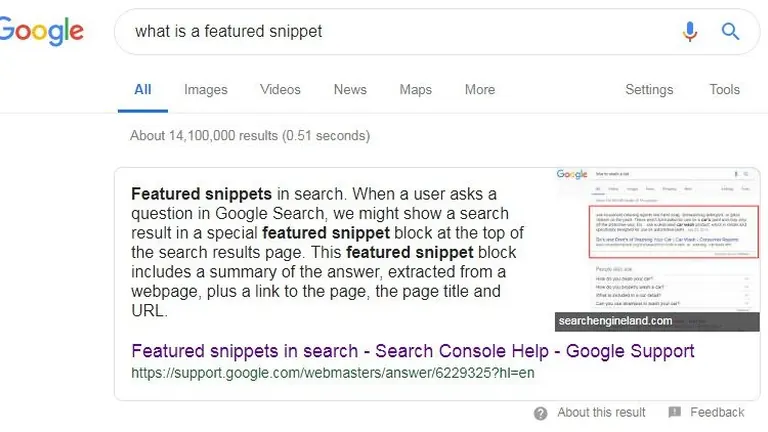
If someone asks what customer relationship management software does, Google could select an explanation from a page and show it as a featured snippet. That's a concrete AEO example. A featured snippet displays an excerpt from a source; it doesn't have to be an AI-generated response.
Give someone seeking a basic definition a clear answer without making them read several paragraphs to find it. Include any condition they need to understand it correctly, then use the rest of the page to explain the details. The answer can be as long as the question requires.
Google chooses featured snippets itself. You can't add markup that designates your page as the selected answer. An FAQ section may be helpful when readers have several related questions, but putting one on every page doesn't establish that the page deserves selection.
A generated comparison or recommendation
If someone asks which software would suit a 20-person agency with specific integration needs, an AI response might compare options using several sources. It could cite a vendor's integration documentation or include that vendor in its recommendations. Those are examples of GEO outcomes.
The information required is more specific than a product definition. Does the integration work on every plan? Can the team import its existing records? Which tasks require another tool? Documented limits help a buyer assess fit as much as a feature list does.
An answer might cite your page to explain a limitation or a general concept without recommending your business. It might also recommend you without linking to your website. When you assess visibility, record citations and recommendations separately so you can see which happened.
GEO refers to generative engines here. It isn't another term for geographic targeting or local SEO. Location can affect the answer someone needs, but it doesn't define this acronym.
Which work can serve all three?
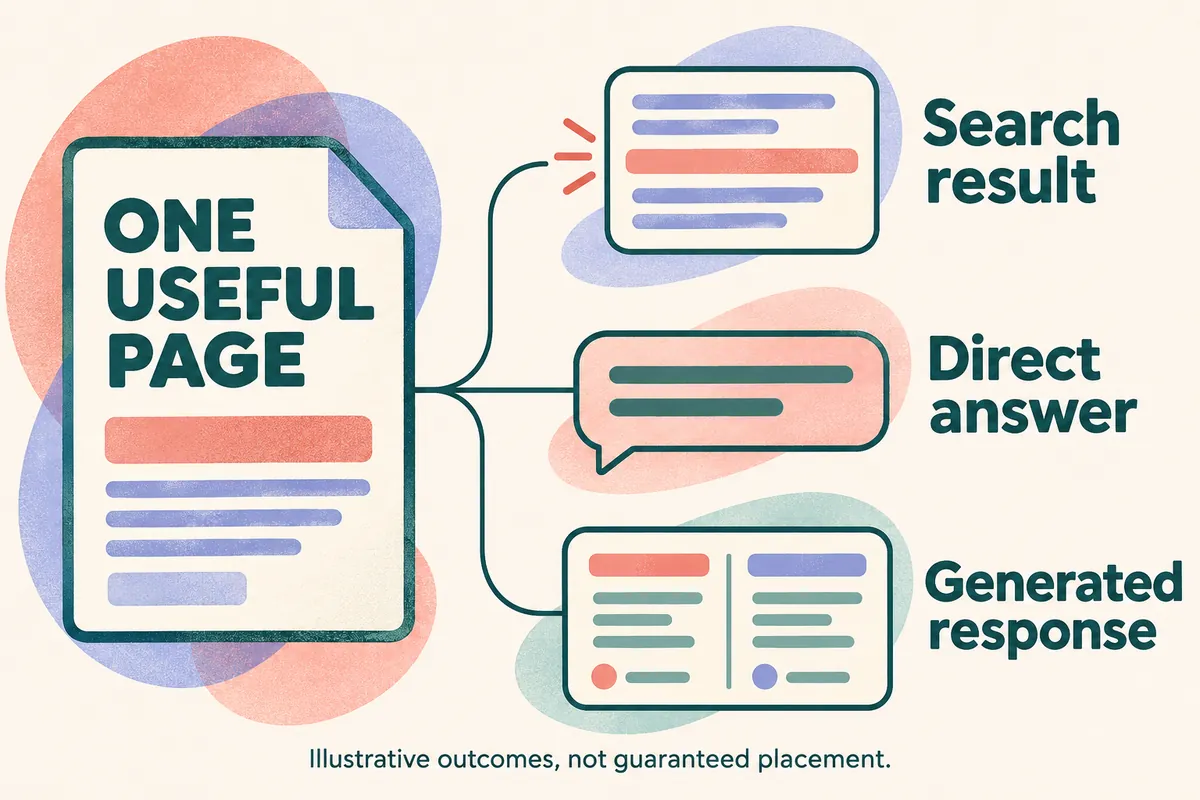
You can often improve one page rather than commission separate SEO, AEO, and GEO versions. A software comparison page can bring in visits from search and answer a buyer's question. An AI response could also use its details to compare products.
Check that search systems can reach and understand the pages with your important information. For Google's AI features, a supporting page must be indexed and eligible to appear with a Search snippet. Google then chooses what to show from the eligible pages.
If a page says that a product connects to another tool, explain what the connection does and where it stops. Update it when the product changes. If you offer a service, describe the scope well enough that someone can compare it with their needs. Clear headings and ordinary sentences help readers find those answers without stripping away the context.
Read the answers that use your information, too. If an AI response repeats an outdated plan limit, look for old information you need to correct. You may also find that buyers are asking an important question your site doesn't answer. Add the details they need.
Google doesn't require special schema or tiny content chunks for generative search, and it ignores llms.txt for Search visibility. Appropriate structured data can still support eligible rich results, so use it for that documented purpose. Check other platforms' guidance for their own access and selection requirements.
How to measure the different results
For ordinary search, impressions tell you that a result was shown and clicks tell you that someone followed it. Your website and sales records help establish whether those visits produced useful inquiries or purchases.
For direct answers, check whether your page supplied the answer and whether the extracted information stayed accurate. If a snippet removes a condition that changes the meaning, appearing there isn't enough to call it a good result.
For generated responses, record mentions of your business and citations of your pages. Note any recommendation of your offering for the situation, and check that the answer gets the facts right. One response can contain all of these, so keep a record of each.
You have more measurement options than manual searches alone. Google Search Console's dedicated Generative AI performance report shows link impressions in AI Overviews and AI Mode. It supports analysis by page, country, device, and date. A site with too few generative impressions may not see the report. Its impressions don't reveal every mention of your business or establish that someone visited.
Bing Webmaster Tools' AI Performance report shows how often your pages are cited across the services it covers. These include Microsoft Copilot and Bing AI summaries. The counts and cited pages can help you see which content gets used. They don't show that every citation had the same prominence or produced a click.
You can also test questions in an AI tool to find details those reports leave out. Save the question, answer, platform, date, and relevant location settings, and repeat comparable checks. If you change the question set, record the change. Report the share of answers where you appear alongside the question set you tested. That sample covers only those questions, so it can't tell you about every answer your customers received.
What should your team do first?
Start with the most important problem on a page customers need. An inaccessible page needs fixing before you spend time on its answer format. Wrong information needs correcting before you try to earn more exposure. Listen for questions buyers keep asking, too. Add a useful answer when the page doesn't give them the detail they need to act.
Then examine how the page appears in ordinary results, direct answers, and the generated responses your customers use. You may find that the same correction improves several parts of the experience, while each still needs its own measurement.
Assign the work to the people with the skills it requires, such as development, product knowledge, writing, or analysis. You can plan around the outcome each acronym describes without creating three copies of a page or hiring three separate teams.